The Future of Digital Marketing

It was the year 2000 when I first started my digital marketing career and 2011 when AJ and I launched our digital marketing agency ThoughtShift.
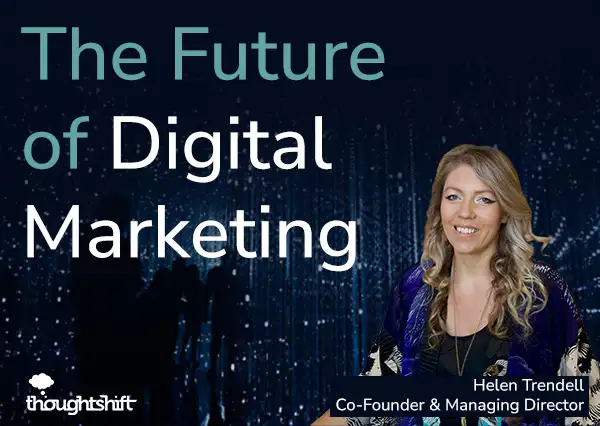
Now celebrating over 25 years in digital marketing and 15 years leading the marketing for our award-winning digital marketing agency - it’s time to share my predictions for the future of digital marketing.
7 Future of Digital Marketing Predictions
- Customer-Centric AI Strategies
- Zero Click Content
- AI Search: GEO, AEO vs LLM SEO
- Social Media SEO
- Human-Centred Storytelling
- Machine Learning Media
- Human-Powered Data Analytics
1. Customer-Centric AI Strategies
If you're already sick of hearing about AI, I’m afraid the age of Web 4.0 is only just dawning. Generative AI and agentic AI are already shaking every industry to the core. Not since the emergence of Google and search engine marketing have we seen such a paradigm shift in human behaviour.
ChatGPT adoption rate twice as fast as Google
The fundamental difference with AI is the adoption curve is happening faster than ever before. Google launched in 1998 and took 9 years to reach 1 billion daily users. ChatGPT already has over 800 million daily users and is predicted to reach 1 billion users in 2026 - only 4 years since launching in 2022.
Whilst many marketing teams are busy adopting AI across the marketing mix for their own benefit to save time and budget, marketing leaders need to pay closer attention to how their customers are using AI. With the gold rush of AI rich in opportunities on one side, the elephant in the room is the Blockbusters-level threat of complete brand obsoletion on the other.
If AI enables your customers to solve their problems in fundamentally new ways, or without your brand at all, the fact AI can help you run your marketing more efficiently becomes irrelevant.
Customer-Centric AI Strategies Takeaway:
Brands who adapt to the rapid pace of changing behaviour by putting their customers’ needs at the heart of AI-powered marketing strategies will be the Netflix-style winners of tomorrow.
2. Zero Click Content
With Google AI Overviews now dominating the majority of search results, many brands are seeing less traffic arriving on their websites. Even brands holding the top organic positions in Google are finding that Google is scraping their content to provide the answer so users don’t need to click through to their website anymore.
Following our ThoughtShift Full-Funnel Methodology, Martin Searle Solicitors, have seen a 75% uplift in total organic lead generation with 14% of organic traffic leads now coming from AI search
Although for retail brands, Google Shopping paid and organic results remain at the top without a Google AI Overview. Similarly, for all high-intent to purchase searches, Google Ads is typically above everything. So whilst many digital marketing experts declare SEO is dead or blogs are dead, our award-winning SEO & PPC agency approach has always prioritised optimising for transactional searches over informational searches.
Low intent to purchase searches will be hit the hardest
If you've historically been optimising for broad high-search volume informational searches over niche high-intent to purchase transactional searches you can absolutely expect your clicks and traffic to reduce dramatically.
The real question is, was that traffic bringing you value?
From analysing 1000s of websites over the years, we know that informational pages such as blogs may only have a conversion rate of 0.1% or less – so you need 1000 sessions or more to generate a lead or sale.
Whereas transactional pages such as services or products pages consistently deliver conversion rates of 2% or more – so you only need 50 sessions to generate a lead or sale.
Zero Click Content Takeaway:
Brands with transactional-first search intent strategies that start with bottom of funnel content optimisation will grow lead generation and sales faster in a zero click world.

3. AI Search: GEO, AEO vs LLM SEO
ChatGPT is now the world’s 5th most visited website, with only Instagram, Facebook, YouTube and Google getting more visitors. Growing exponentially, with ChatGPT the world’s 17th most visited website only a year ago, getting recommended by generative AI’s Large Language Models (LLMs) through Generative Engine Optimisation (GEO) or LLM SEO is now key to the future of digital marketing.
Similarly, with Google rolling out AI Overviews at the top of traditional search results, Answer Engine Optimisation (AEO) is the practice of being featured within the summarised answers by Google’s generative AI, Gemini or Microsoft’s CoPilot.
Holistically described as AI Search, GEO, AEO and LLM SEO use many of the same principles as traditional search engine optimisation (SEO) such as optimisation of onsite content contained within metadata and structured data such as headers and schema markup, as well as offsite brand mentions optimisation across 3rd party websites and social media.
Following our ThoughtShift Full-Funnel Methodology, Martin Searle Solicitors, have seen a 75% uplift in total organic lead generation with 14% of organic traffic leads now coming from AI search. Using our human-powered “How did you hear about us” data analytics method, we’ve proven a 50% year on year uplift in employment law sales conversions from organic traffic with 30% of sales from ChatGPT, Gemini and Google AI Overviews. Most significantly, AI search leads convert to sales at a higher conversion rate than traditional organic search leads.
AI Search: GEO, AEO vs LLM SEO Takeaway:
Brands proven to drive lead generation and sales from AI Search have high performance websites with customer-centric content and a positive online brand reputation. Brands already winning the most new clients from AI Search have case studies, certifications and testimonials on their websites together with external social proof such as reviews, awards, press coverage and user generated content on social media sites like Instagram, LinkedIn, YouTube and Reddit.
4. Social Media SEO
Whilst Google has held around 85% of search engine market share since the early 2000s, SEO has never only been about Google. Bing, owned by that other big tech behemoth, Microsoft, has been another search engine that our Bing SEO techniques have proven worthwhile to optimise for – especially for brands looking to reach an older or more corporate B2B audience.
As Digital Natives made up of Millenials, Gen Zs and Gen As represent a growing proportion of global internet users, we anticipate search behaviour will continue to shift away from traditional search engines such as Google to social media platforms such as YouTube, TikTok, LinkedIn and Instagram.
However with Google’s predominantly ad-driven revenue of $400 billion at stake and owning both the first and second most visited websites in the world - Google and YouTube, Google is not losing search market share without a fight. In fact, further blurring the lines between SEO and social media, Google now pulls Instagram, LinkedIn and Reddit content into the search results alongside website pages and YouTube videos.
With big tech social media and AI companies reverse-engineering Google’s algorithms to utilise for their own platforms, applying Google SEO principles is proven to directly benefit YouTube SEO, TikTok SEO, LinkedIn SEO and Instagram SEO.
Social Media SEO Takeaway:
Brands with a Social Media SEO strategy based on Google’s Search Quality Rater Guidelines that adapts assets for websites, apps and social media platforms relevant to their audience such as YouTube, Instagram and TikTok will gain the greatest global brand visibility.
5. Human-Centred Storytelling
Whilst AI agents are going to be helping us with the research, humans will still be making the decisions.
Producing authentic communications that put real humans at the centre is the key to cutting through the AI slop noise.
Stories that resonate psychologically and emotionally, showing real customer problems and solutions also have the benefit of connecting with the exact ideal customer profiles brands are looking to reach.
So when customers do discover brands that resonate with them, they are also more likely to comment, share, buy, keep buying and tell their friends. This creates a virtuous circular economy-driven cycle of positive impact, creating delighted customers, done-for-you brand awareness and a customer-get-customer multiplier effect.
With human-centred storytelling, the more customers you resonate with, the more customers like them you’ll attract.
For B2C brands, human-centred storytelling strategies could include:
- User generated content (UGC) from delighted customers sharing before and after images and videos of the product or service impact.
- Product or service explainer videos from the perspective of specific customer segments shared across website landing pages, email marketing funnels, YouTube videos and social media posts.
For B2B brands, human-centred storytelling strategies could include:
- Employee generated content (EGC) of team members sharing expert advice through blogs, videos and podcast interviews.
- Client testimonials and case studies relevant to different sectors presented through landing pages, presentation assets, social media posts and YouTube videos.
Human-Centred Storytelling Takeaway:
Brands using human-centred storytelling across website, video and social media content will attract more of their ideal customers to them creating a customer-get-customer multiplier effect.
6. Machine Learning Media
Google Ads has been migrating its paid ads management away from manual optimisation and towards a machine learning driven model for years.
Launched in 2003, Google Ads Quality Score was one of the first algorithmic features to optimise ad placement. Launching in 2021, Performance Max Ads saw a significant departure away from human optimisation control with placement decisions and performance insights being relinquished to machine.
Whilst many brands have set campaign goals to target return on ad spend (ROAS) and cost per acquisition (CPA) to achieve just that, other brands have experienced a drop in Google Ads performance – even if they can see they are driving increased lead generation and ecommerce revenue from their own data.
Inaccurate data is costing brands millions in lost lead generation and revenue
The major downside of machine learning media is unmeasured conversions ultimately mean you’re leaving money on the table. If you know you got a contact form completion or ecommerce order through from your back-end systems, but Google’s machine learning doesn’t have the conversion or purchase value in the dataset, then it cannot use that data to personalise future ads for that user or show relevant ads to other users like them.
To help machine learning media make target CPA and target ROAS decisions as well as use features like ad personalisation and remarketing, all conversion data – both paid media and organic media conversions - must be effectively tracked using Consent Mode v2 and Enhanced Conversions.
With Microsoft Ads, Meta Ads and TikTok Ads increasingly using machine learning formats for their ad platforms and the highly anticipated launch of ChatGPT Ads, the expansion of machine learning media is expected to dramatically accelerate in 2026.
Machine Learning Media Takeaway:
Brands using machine learning media together with accurate conversion measurement across the customer journey both online and offline will realise the best possible paid media performance.
7. Human-Powered Data Analytics
If data is the new gold, human-powered data analytics is the new goldmine.
Many brands were caught by surprise when the old Universal Google Analytics was sunsetted in July 2023 and replaced with the new Google Analytics 4 (GA4). Not only did GA4 introduce a new data-driven attribution model, but also a range of new default channel groups giving brands who rely on performance data to drive their business decisions a serious problem.
Universal Google Analytics vs GA4 Traffic Sources
- PPC was split into Paid Search, Cross-Network and Paid Shopping.
- SEO was split across Organic Search and Organic Shopping.
- Social Media was split into Organic Social and Paid Social.
Hot on the heels of the GA4 switch, the Digital Markets Act came into effect with the powers to fine big tech up to 20% of their billion-dollar revenues if any non-consented data is shared with their platforms.
Google Ads Consent Mode v2
Google Ads Consent Mode v2 launched just in time to ensure only consented data can be shared from a website to Google via the use of a Google-approved Consent Management Platform (CMP) such as CookieYes or Iubenda. The major benefit for brands being Consent Mode v2 data can be used by Google Ads within Google’s machine learning to help brands generate more brand awareness, traffic, leads and sales through ad personalisation and remarketing.
Martech Stack Complexity
Now in 2026, only a tiny fraction of brands have accurate consent-based data flowing between every aspect of their full martech stack including:
- Content Management System e.g. WordPress, Shopify
- Consent Management Platform e.g. Cookiebot, Iubenda
- Google Analytics
- Google Tag Manager
- Google Ads
- Meta Ads
- CRM systems e.g. Hubspot, Salesforce, Zoho CRM
- Email marketing systems e.g. Mailchimp, Klaviyo
- Ecommerce payment providers e.g. Visa, Mastercard, Stripe, PayPal, Apple Pay, Google Pay, Klarna
The Mismeasurement Trap
The mismeasurement trap many brands fall into is that when data is being misreported - typically under the wrong channel - bad marketing decisions are made to switch off what appears to be under-performing channels or campaigns. Which results in further decline in marketing, sales and ecommerce performance.
Mis-attributing Direct traffic and conversions is a common symptom. Direct traffic has never only consisted of people typing the website domain directly to their browser. Direct traffic has always included “Other traffic sources” that Google Analytics has not been able to or allowed to report on.
Changes in human behaviour such as use of VPNs, privacy-first software, automatic cookie decline tools and multi-device journeys compound the growth in Direct traffic and conversions even further. Ultimately, if Direct traffic and conversions are growing it’s more likely to be marketing than magic.
Human-Powered Direct Traffic Analysis
When you check Direct traffic landing pages and sort by conversions rather than sessions, human-powered data analytics will often reveal almost all Direct traffic conversions are not from the home page. When conversions are driven from deep pages on the site that no human has directly typed into their browser this is due to customers landing on pages from search engines, LLMs or sharing links via a new device, social media or email. When landing pages have 100% conversion rates from seemingly landing directly on the thank you page, this is more likely due to opted out consent where Google is legally unable to attribute the marketing source.
Human-Powered Data Analytics Takeaway:
Brands that pioneer human-powered data analytics with accurate consent-based 1st party data across their martech stack together with human-powered decision making will drive world-class digital marketing performance – and be the few with the data evidence to prove it!
Future of Digital Marketing Next Steps
In a world with so many technological, social and legal changes, one thing is certain - the future of digital marketing will continue to evolve at an accelerating pace.
The lines between performance and brand are blurring, whilst traditional digital media and measurement are fragmenting.
There will be winners and losers of the future of digital marketing race, with those pioneering new opportunities now gaining first mover advantage and those slow to adapt suffering from declining results.
To learn more about how our award-winning ThoughtShift Full-Funnel Methodology moves the needle on brand performance across the customer journey, contact our experts for a free digital marketing consultation.