
SEO Content Strategy in 2026: Topics, Structure and Search Intent

At ThoughtShift, we spend a lot of time exploring how people search, how Google understands content, and what genuinely helps brands grow online. While SEO constantly shifts, the core principles of good content, good structure, and good user experience stay the same.
So, here's a practical, easy-to-follow breakdown of current SEO content strategy best practices, explained clearly and focused on what actually works.
1. Start With the Essentials
Before diving into anything advanced, your website needs a strong foundation.
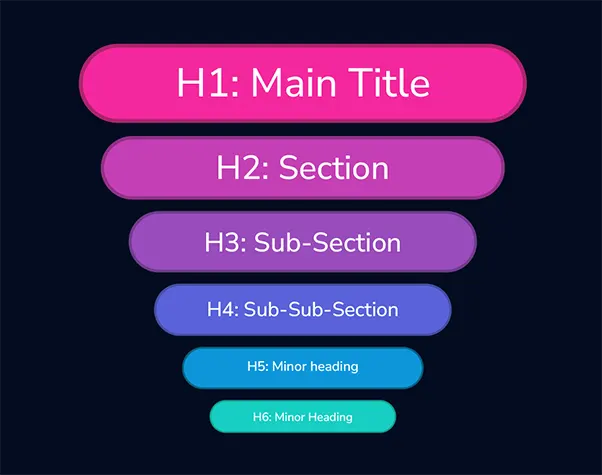
- Use clear headings (H1, H2, H3) to guide both users and search engines. This graphic illustrates the hierarchy which helps Google understand your content structure and makes it much easier for users to read and navigate your page
- Keep paragraphs short and scannable
- Add images or videos to boost engagement
- Use internal links with descriptive, keyword-rich anchor text
- Don't forget meta titles, descriptions, and structured data/schema
Get these right and you'll see the biggest impact, they're the first things worth optimising.
2. Audit Your Existing Content
A great SEO strategy always starts with understanding what you already have and what's missing. The SEO Project reports that in 2025, "80% of B2B marketers achieve their goal of creating brand awareness through content marketing," highlighting just how powerful well-optimised existing content can be. Auditing helps you spot opportunities to improve, expand, and make your content more useful than your competitors.
Some quick wins when auditing:
- Use tools like Google Search Console to see queries you're already appearing for, including impressions, clicks, click-through-rate (CTR) and average position
- Check Google's People Also Ask questions, which uncovers the questions users are genuinely asking, then make sure your content addresses those topics
- Look at competitors ranking well and analyse what their content covers
- Use keyword tools (Keyword Planner, Ahrefs, Google Trends) to spot new themes
- Try site search queries (e.g., site:yourwebsite.com "keyword") to see how well you cover a topic
The goal? Find gaps, remove overlaps, and make your content more useful than anyone else's.
Our SEO content strategy for Martin Searle Solicitors began with a rigorous content audit combined with data-driven keyword expansion to ensure every page of their site was optimised for maximum search visibility, resulting in a 75% uplift in total organic lead generation.
3. Think in Topics, Not Just Keywords
Google is much smarter now. It understands synonyms, intent, and how a topic connects across multiple pages.
Instead of forcing 1-2 keywords on a page, focus on:
- Covering the wider theme
- Adding FAQs and examples
- Including related subtopics
- Using variations of your keywords naturally
This creates a stronger topical footprint, exactly what Google rewards. It will also improve your chances of showing in the AI Overviews or in the large language models (LLMs) such as ChatGPT or Gemini. These AI summaries (as seen in the screenshot below) often pull from multiple high-quality sources, showing users both answers and the websites that rank well for the topic, giving your content more visibility and credibility.

4. Build Authority With Smart Structure
Website authority is built on the overall strength of your content, and it doesn't come from one amazing page, it comes from a network of high-performing, interlinked pages.
A few key principles:
- Keep content logically structured and easy to read
- Use internal links to connect your most important pages
- Include long-tail keywords to reach more specific search intents
- Write in the tone your audience actually uses
- Regularly review performance for drops in CTR, impressions or ranking
Small, consistent optimisations over time add up to big gains.
5. Create Pillar Pages & Cluster Content
This structure is still one of the most effective SEO strategies.
Pillar Pages: The big, comprehensive guides on a topic. They act as the "hub."
Cluster Content: Supporting pages that explore subtopics in more depth. These all link back to the pillar page and to each other where relevant.
This signals to Google that you fully cover the subject, which boosts your topical authority dramatically.
According to HubSpot, after implementing a pillar and topic cluster strategy, one company tripled its organic traffic in just six months, and grew traffic by over 500% within a year. This shows how powerful pillar and cluster content can be for increasing topic authority and driving long-term organic growth.
6. Avoid Keyword Cannibalisation
One of the easiest ways to hold a site back is when multiple pages try to rank for the same keyword, ending up conflicting against each other.
To prevent this:
- Make sure each page has its own keyword focus
- Don't spread variations of the same keyword across competing pages
- Use a clear table of contents on long pages so users (and Google) know what's covered
- Map keywords before creating new content
A clean, focused site structure makes ranking far easier.
7. Keep Content Fresh
SEO content strategies aren't a one-and-done job. Your content needs revisiting, especially if you see:
- Falling impressions
- Declining CTR
- Drops in average ranking position
- Pages disappearing from AI Overviews/snippets
- New customer enquiries that don't match your content
Regular updates keep content accurate, relevant, and competitive.
8. Understand User Intent & User Experience
Google wants users to be happy. So a big part of your SEO strategy is making your content genuinely helpful.
Try:
- Adding images, examples and simple explanations
- Tailoring content to real audience pain points (Reddit is great for this)
- Making answers clear at the top of the page so they are easy to find first, then going deeper
- Checking metrics like time on page, engagement rate and exit rate in Google Analytics (GA4)
Greater engagement with your content leads to greater visibility on Google.
We applied these exact UX principles to our work with ecommerce brand, Marine Super Store. By aligning their SEO and PPC strategies, we didn't just drive "clicks", we drove shoppers. We overhauled the site's user journey to ensure that whether a customer arrived via a paid ad or an organic search, they landed on a page optimised for their specific stage of the buying cycle. By simplifying navigation and clarifying product information, we helped them achieve a 20x Return on Investment (ROI).
Conclusion
SEO doesn't have to be complicated. With the right structure, clear content, and ongoing optimisation, you can steadily grow your visibility and authority. At ThoughtShift, we've seen time and time again that the best results come from focusing on users first. Our SEO specialists have driven results such as a 147% year-on-year increase in organic revenue for technology retailer Calumet Photographic, part of an integrated SEO and PPC strategy that grew total revenue from £3 million to £11 million.
If you'd like support reviewing your digital marketing strategy or shaping a content plan that actually drives growth, we're here to help. We combine audience research, keyword insights, technical auditing, competitor analysis and data-led planning to build strategies that are tailored to your brand and your goals.
If you're ready to see meaningful improvements in your website's SEO performance, get in touch for a free SEO consultation.